
Houston Truck Windshield Repair & Replacement: Pickups, Semis & Fleet Vehicles
Truck windshields face a different category of stress than passenger car glass. This guide covers what separates truck glass work from standard replacement, and what fleet operators and independent drivers need to know before scheduling.

15–25%
Larger than sedan glass
60–120
Minutes per replacement
OOS Risk
Cracked glass = inspection failure
Mobile
Depot and yard service available
PICKUP TRUCKS
Modern Pickup Truck Windshields:
What Makes Them Different
The modern full-size pickup is no longer just a work vehicle with basic glass. The windshields on an F-150, Silverado 1500, RAM 1500, Tundra, or Tacoma share the same layered laminate technology and ADAS integration found in premium passenger cars, but they also come with physical distinctions that affect both sourcing costs and installation complexity.
The most immediate difference is surface area. Pickup truck windshields run roughly 15 to 25 percent larger than a comparable sedan. Because glass is priced in proportion to material volume and curvature complexity, that size difference translates directly to higher cost before installation labor is considered. Windshield rake angle (how steeply the glass tilts back from vertical) also runs shallower on many trucks than on low-slung sedans, which affects adhesive bead geometry and the time needed for a proper cure before the vehicle is safe to drive.
The full windshield replacement process is the same for trucks as for passenger cars, but the physical scale, integrated features, and ADAS requirements all demand extra attention at each step.
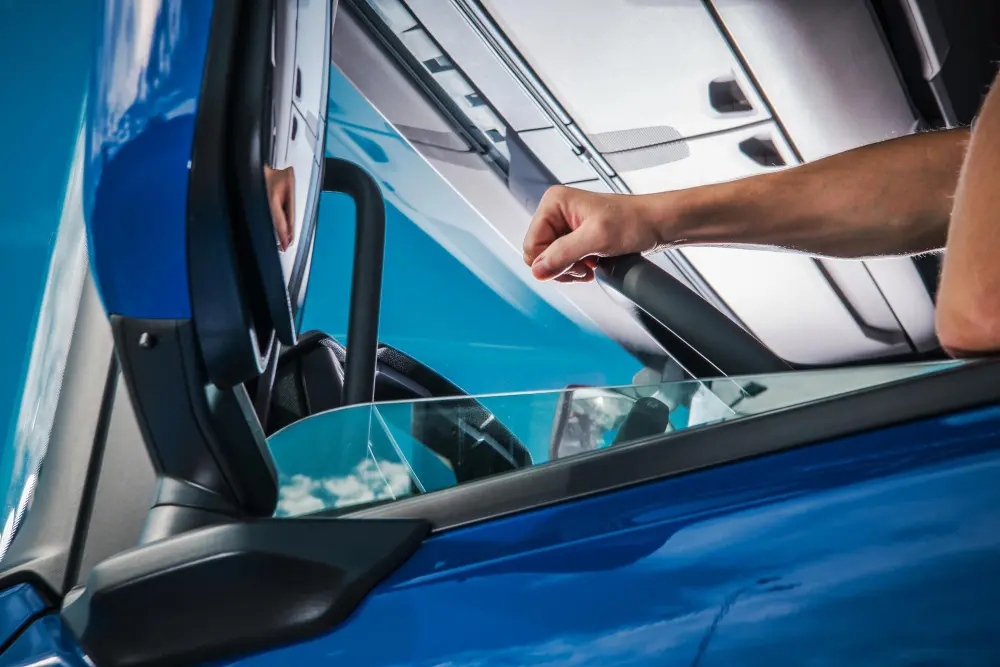

Glass Size
Pickup windshields run 15 to 25 percent larger than comparable sedan glass. This drives higher OEM and OEE panel costs regardless of vehicle tier, and larger glass requires more adhesive and a longer uniform cure to seal properly across the full perimeter.

Rake Angle
Many pickups carry a more upright windshield angle than passenger cars, particularly on work-oriented trims. This affects adhesive bead geometry, how the glass seats against the pinch weld, and safe drive-away timing in high-temperature conditions like a Houston summer midday.

Integrated Features
Premium and mid-tier pickup trims routinely include rain-sensing wiper zones, heated wiper park areas that prevent ice build-up at the blade base, and acoustic interlayer glass that reduces road noise transmission. Each of these features requires a match in the replacement glass, or the feature ceases to function after installation.

ADAS Requirements
Any pickup manufactured from approximately 2018 onward with a forward-facing camera requires post-replacement ADAS calibration. This applies to all front collision warning, lane-departure, and adaptive cruise systems regardless of trim level. The process is identical to passenger car calibration — we confirm your specific truck’s calibration requirements when you call with the VIN.
COMMERCIAL VEHICLES
Semi-Trucks and Class 7–8 Commercial Vehicles
Semi-truck windshield work sits in its own category. The glass is larger, the access geometry is more complex, the sourcing chain differs from the passenger vehicle market, and the regulatory stakes are higher. A cracked windshield on a commercial truck is not just a visibility hazard; it is a documented compliance failure that can pull a driver and their load off the road during a routine DOT inspection.
|
DOT |
A crack in the driver’s primary viewing area constitutes a violation under FMVSS and can result in an out-of-service order during roadside inspection. Commercial drivers cannot treat glass damage as a deferred maintenance item. |
Single vs. Two-Piece Glass
Older Class 7 and Class 8 trucks, particularly long-haul Freightliners, Kenworths, and Peterbilts from earlier generations, used two-piece windshields with a metal divider bar running vertically down the center. Most newer models have moved to single-piece glass, which improves visibility and reduces seal complexity. Sourcing requires specifying not just the make and model but the model year and cab configuration to get the correct piece.
FMVSS 205 Compliance
All replacement glass for Class 7 and Class 8 commercial vehicles must meet FMVSS 205 safety glazing standards. This governs optical clarity, impact resistance, and the marking requirements DOT inspectors look for when checking a windshield. Using non-compliant glass creates liability exposure for both the operator and the carrier, regardless of whether a roadside inspection identifies it immediately.
Makes We Source Glass For
A Plus Auto Glass sources commercial windshields for Freightliner, Kenworth, Peterbilt, Volvo Trucks, and International, covering both current production models and units from previous model generations. Availability and lead time vary by make and model year — call with your truck’s VIN for the most accurate sourcing timeline before committing to a service date.
On-Site Mobile Service
Bringing a semi to a shop is not always practical, particularly for long-haul operators based at distribution centers or freight yards. We provide mobile installation at depots, truck stops, and commercial facilities throughout the Houston metro area. For carriers managing time-sensitive loads, mobile service keeps the truck moving without a separate trip to a fixed location.
FLEET SERVICE
Fleet Windshield Service Programs
Fleet operators managing multiple trucks face a different set of challenges around auto glass than individual vehicle owners. Downtime has a direct cost, glass damage occurs at a higher frequency than in passenger vehicle fleets, and managing individual insurance claims and scheduling across multiple units becomes its own operational burden. A Plus Auto Glass builds fleet programs around eliminating those friction points.

01
Makes We Source Glass For
A Plus Auto Glass sources commercial windshields for Freightliner, Kenworth, Peterbilt, Volvo Trucks, and International, covering both current production models and units from previous model generations. Availability and lead time vary by make and model year — call with your truck’s VIN for the most accurate sourcing timeline before committing to a service date.
02
Mobile Yard Service
We come to your depot, yard, or distribution center rather than pulling vehicles off-site. For fleets with multiple units needing service on the same day, batched mobile visits eliminate the coordination overhead of individual shop appointments.
03
Consolidated Billing
Fleet accounts receive consolidated invoicing and insurance coordination rather than per-vehicle claims administration. This simplifies accounts payable for fleet managers and reduces the administrative overhead of glass-related insurance documentation.
04
Standardized Sourcing
Fleet consistency matters when the same make and model appear across dozens of units. Standardized sourcing ensures every vehicle receives the same glass grade and installation specification, simplifying maintenance records and warranty tracking across the fleet.
05
Volume Pricing
Volume pricing applies to operators managing three or more vehicles on an ongoing basis. Pricing structures are built around usage patterns and can be adjusted as fleet size changes. Contact us to discuss arrangements for your fleet’s specific profile.
06
Compliance Documentation
All commercial fleet replacements include installation documentation confirming FMVSS-compliant glass specifications. The records are needed to demonstrate glass compliance during DOT audits or in the event of an insurance claim involving windshield condition.
Fleet arrangements are customized around vehicle type, service frequency, and operational geography. Call us to discuss what a fleet program looks like for your specific operation — there is no one-size solution, and we build programs around how your trucks actually run.
Client Testimonials
These guys did a great job on repairing/replacing the driver-side glass on my Mercedes SL550. The prices were very competitive, and they really went over the top on accommodating my weird scheduling. Truly 5-Star! Thanks guys…BTW, the shop/showroom was immaculate!
I had my car’s windows tinted here, and I’m beyond happy! The service was fast, and the tint is high quality. It really helps with glare and heat. Definitely recommending them to friends.
I don’t ever write reviews, but I wanted to make sure I shared my experience with these guys. Best price in the city, extremely quicker than everyone else estimated, and they did a great job. They even vacuumed the residue of the glass from under my seat. Would definitely recommend them!
FREQUENTLY ASKED QUESTIONS (FAQs)
How long does a truck windshield replacement take?
Pickup truck replacement typically runs 60 to 90 minutes for the installation itself. If ADAS calibration is required — which applies to most 2018 and newer pickups with a forward-facing camera — add 30 to 60 minutes for static calibration and additional time for a dynamic road drive if your truck’s system requires it. Semi-truck and Class 7/8 commercial glass takes 90 to 120 minutes due to larger panels, more complex access geometry, and additional handling required for two-piece glass on older models. Adhesive cure time applies to all vehicles and must be factored into scheduling before the vehicle returns to service.
Can you service semi-trucks and commercial vehicles at our location?
Yes. Mobile service is available for semi-trucks at depots, distribution centers, freight yards, and truck stops throughout the Houston metro area. For fleet operators with multiple units at a single location, we can schedule batched mobile visits to service several vehicles in a single trip. The installation quality and glass specification are identical to in-shop work — the only difference is that we come to where the truck is parked. Call to discuss mobile scheduling logistics for your specific facility.
Will a cracked windshield actually fail a DOT roadside inspection?
Yes. Under DOT inspection criteria, a crack that falls within the driver’s primary viewing area (generally the area swept by the windshield wipers) constitutes a defect that can result in an out-of-service order. This means the vehicle cannot legally continue operating until the defect is corrected. FMVSS glazing standards also require that replacement glass carry the correct compliance markings, which is why using non-compliant aftermarket glass on a commercial vehicle creates both operational and liability risks. Commercial drivers and fleet operators should treat cracked windshields as a scheduling priority rather than a deferred maintenance item.
Do pickup trucks need ADAS calibration after windshield replacement?
If your pickup was built from approximately 2018 onward and equipped with a forward-facing camera — which covers the vast majority of current F-150, Silverado, RAM 1500, Tundra, and Tacoma models — then ADAS calibration is required after replacement. The new glass changes the optical path the camera looks through, and even OEM glass requires recalibration because the camera’s position relative to the glass shifts slightly during installation. We perform static and dynamic calibration in-house and confirm your truck’s specific calibration requirements when you call with the VIN.
A PLUS AUTO GLASS · FLEET & COMMERCIAL · HOUSTON, TX
Pickups, Semis, and Fleet Glass — One Call.
OEM and FMVSS-compliant glass for pickups, semis, and commercial fleets. Mobile depot service. Priority fleet scheduling. Insurance and DOT documentation handled. Call to confirm availability and schedule.
Schedule Truck Glass Service.
A Plus Auto Glass serves pickup owners, independent truckers, and commercial fleets across Houston. For technical details on the replacement process itself, see our general windshield replacement guide. For rear cab glass, see our truck back window replacement page.