
Windshield ADAS Calibration:
How It Works and When You Need It
After windshield replacement, the camera your vehicle relies on for automatic braking, lane-keeping, and adaptive cruise needs to relearn where it is in space. Skipping that step doesn’t just disable the system; it leaves it active and running on incorrect data.
What ADAS Calibration Actually Is
Most vehicles built after 2015 carry at least one windshield-mounted sensor. In many vehicle makes and models, this is a forward-facing camera positioned near the rearview mirror mount that powers systems like automatic emergency braking, lane-departure warnings, and adaptive cruise control. Some also include radar emitters, LiDAR arrays, or millimeter-wave sensors integrated into or near the glass.
When the windshield is replaced, the physical relationship between each of these sensors and the glass surface changes. Even if the new glass is identical in specification to the original, installation shifts the camera’s position relative to the glass by fractions of a millimeter. At highway distances, fractions of a millimeter translate to feet of measurement error.
ADAS calibration is the process of realigning these cameras and sensors to manufacturer-defined reference points after replacement — resetting the system’s understanding of where it sits in space, what angle it’s looking at, and how to interpret what it sees.
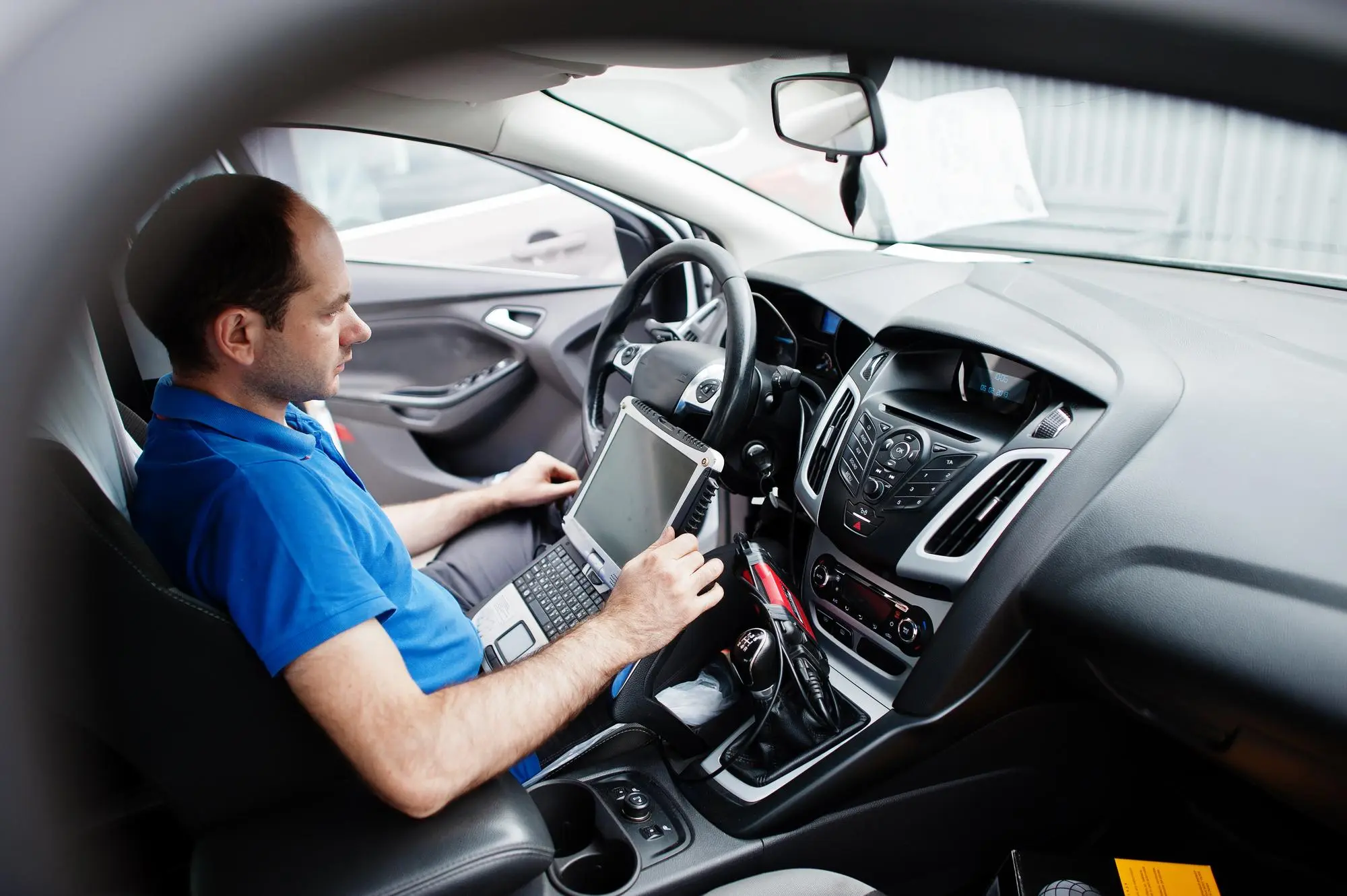
A correctly replaced windshield with no recalibration is not a safe vehicle. The ADAS systems remain active and will act on measurement data that no longer reflects reality. The consequences range from nuisance false braking to failure to brake when it matters.
CALIBRATION METHODS
Static, Dynamic, and Dual Calibration — What Each Involves
There are three calibration protocols, and which one your vehicle requires depends on the manufacturer’s system design. Some vehicles support only one method; others require both in sequence. Using the wrong method or skipping one step in a dual-calibration sequence means the system is partially calibrated, which is not the same as being fully calibrated.

Static (In-Shop Only)
The vehicle is stationary in a controlled indoor environment. A precisely manufactured target board is positioned at an exact distance and height in front of the vehicle (these measurements vary by manufacturer and model). An OBD-II diagnostic tool connects to the vehicle’s computer and runs a calibration routine that uses the target’s known dimensions and position to reset the camera’s reference data.
Requires a level floor, controlled lighting conditions, and specific clearance around the vehicle. Cannot be performed outdoors or in driveways.
Environment Requirements
Level indoor floor
Controlled lighting
Measured distances
Clearance per OEM spec
Dynamic (On-Road)
The vehicle is driven on a road with clearly visible lane markings at speeds between 25 and 65 mph. As the vehicle moves, the camera system self-calibrates by processing lane markings, road geometry, and real-world visual references in real time. The system gradually refines its reference data until it reaches manufacturer-defined calibration thresholds.
Can be performed after mobile installation, provided roads with clear lane markings are accessible. Requires a diagnostic tool to monitor calibration status and confirm completion.
Environment Requirements
Clear lane markings
Driving at 25–65 mph
Daylight preferred
Diagnostic tool monitoring
Dual (Both Required)
Some manufacturers, including Toyota, Subaru, and Honda, require both static and dynamic calibration performed in sequence for the calibration to be considered complete. Static calibration sets the baseline camera reference data first; dynamic calibration then fine-tunes that baseline against real-world conditions. Completing only one step leaves the system partially calibrated.
Dual calibration cannot be performed by mobile-only services. The vehicle must come into the shop for the static phase before any road drive.
Vehicles Typically Requiring Dual
Toyota / Lexus Pre-Collision
Subaru EyeSight
Honda Sensing
Select BMW / Mercedes models
2015+
Vehicles likely require calibration after replacement

1°
Misalignment = several feet offset at 100 yards
30–90
Minutes for full calibration procedure
All 2018+
Camera-equipped vehicles require recalibration
VEHICLE COVERAGE
Which Vehicles Require ADAS Calibration?
In practical terms: if your vehicle was manufactured in 2018 or later, assume calibration is required after windshield replacement until confirmed otherwise. If it was manufactured between 2015 and 2017, check for forward collision warning, lane departure, or adaptive cruise in your vehicle’s features list. The following measurements are covered by our calibration equipment and protocols:
|
Toyota/ Lexus Pre-Collision System — dual calibration |
Honda/ Acura Honda Sensing — dual calibration |
Subaru EyeSight — dual calibration required |
|
Ford/ Lincoln Co-Pilot360 — static or dynamic |
Chevrolet/ GMC Safety Assist — static |
Nissan/ Infiniti Safety Shield — static or dynamic |
|
Hyundai/ Kia SmartSense/ Drive Wise — static |
BMW Active Driving Assist — dual calibration |
Mercedes-Benz Driver Assistance — static required |
|
Audi/ Volkswagen Travel Assist/ IQ.Drive — static |
Mazda i-Activsense — static calibration |
Tesla Autopilot/ FSD — specialized protocol |
Not sure whether your specific vehicle requires calibration after windshield replacement? Call us at (346) 833-8181 with your VIN, and we’ll confirm the manufacturer protocol before scheduling.
AFFECTED SYSTEMS
Which ADAS Features Require Calibration?
Calibration requirements apply to any system that depends on the forward-facing windshield camera for its input data. That covers more features than most drivers expect.
Forward Collision Warning/ Automatic Emergency Braking
Measures the following distance and closing speed. Miscalibration causes phantom braking or failure to respond to actual obstacles.
Lane Departure Warning/ Lane-Keeping Assist
Detects lane markings and vehicle position within the lane. Miscalibration can trigger false warnings or steer toward the wrong boundary.
Adaptive Cruise Control
Uses camera and radar together to maintain following distance. Camera miscalibration affects target vehicle identification and distance calculations.
Traffic Sign Recognition
Reads speed limit and regulatory signs in the camera’s field of view. Optical misalignment causes signs to fall outside the recognition zone.
Automatic High Beam Assist
Detects oncoming headlights and automatically dips high beams. Camera angle shift causes delayed or missed detection of approaching vehicles.
Rain-Sensing Wipers (Camera-Integrated)
On vehicles where wiper sensing is managed through the camera system, calibration affects the sensitivity threshold for automatic activation.
Head-Up Display Alignment
Projects speed and navigation data onto the windshield. Glass replacement can shift the projection surface, causing display misalignment or distortion that requires recalibration.
Pedestrian and Cyclist Detection
A subcategory of AEB that specifically tracks humans and cyclists. Camera angle shifts can cause detection failure for non-vehicle objects in the vehicle’s path.

SAFETY CONSEQUENCES
What Happens When Calibration Is Skipped
Skipping calibration doesn’t turn off ADAS features. The systems remain active and operational, yet the vehicle’s dashboard shows no warning lights, since the features respond to inputs, which makes everything appear to be working normally. The problem is that the data these systems are acting on is no longer accurate.
The Physics of Miscalibration
A camera misaligned by a single degree, less than the variation introduced by a glass installation with no calibration, projects its measurement error forward at roughly 1.75 feet per 100 feet of distance. At a typical highway following distance of 300 feet, the camera’s “read” of a vehicle ahead’s location can be off by more than 5 feet. That’s not a rounding error in a safety system; rather, it’s the difference between braking in time and not braking at all.
In practice, this means:
- AEB that brakes for phantom obstacles that don’t exist, or fails to brake for real ones.
- Lane-keeping that steers the vehicle toward the wrong lane boundary.
- Adaptive cruise that follows at distances the driver didn’t set.
- Traffic sign recognition misses regulatory signs when the camera is pointed away from them.
Every consequence of miscalibration involves a safety system actively working against the driver’s interests rather than with them.
Frequently Asked Questions
How long does ADAS calibration take?
Static calibration performed in-shop typically takes 30–60 minutes, depending on vehicle complexity and whether the diagnostic routine requires repeat passes. Dynamic calibration adds 15–30 minutes on the road. Dual calibration, involving both methods in sequence, runs 60–90 minutes total for the calibration portion, not including the windshield replacement if bundled. We give you a time estimate before work begins based on your specific vehicle and calibration requirements.
Can calibration be performed at my location, or does the vehicle need to come in?
Dynamic calibration can be performed after a mobile windshield installation. This is possible because it requires only a road drive on lane-marked roads, not a shop environment. Static calibration, however, cannot be performed at a customer location. It requires a level indoor floor, controlled lighting, and precise measurement clearance around the vehicle that a driveway or parking lot cannot provide. If your vehicle requires static or dual calibration, it needs to come in for that phase. We’ll confirm your vehicle’s requirements when you call, so there are no surprises about what can be done where.
Does calibration need to be redone after a chip or crack repair?
Usually not. Chip repair and crack repair do not move the glass, meaning the windshield stays bonded in place, and the camera’s position relative to the glass doesn’t change. Recalibration is specifically triggered by windshield removal and reinstallation. However, if a chip or crack is located directly in or adjacent to the ADAS camera’s field of view, the repair resin can affect the optical path the camera uses. In those cases, we recommend confirming ADAS performance after repair, and in some instances, recalibration is advisable. We assess each repair for camera proximity before completing the work.
What does calibration cost, and does insurance cover it?
Calibration cost varies by vehicle make, model, and which calibration method is required — dual-calibration vehicles incur more time and therefore more cost than single-method vehicles. When calibration is performed as part of a windshield replacement covered by comprehensive insurance, the calibration cost is typically included in the insurance claim. Standalone calibration, usually performed after someone else’s replacement that omitted recalibration, is billed separately based on vehicle requirements. We provide a clear cost breakdown before work begins and handle insurance documentation directly.
Can any shop perform ADAS calibration?
No. ADAS calibration requires manufacturer-specific diagnostic equipment. Generic OBD-II readers cannot initiate or monitor calibration routines for most systems. Each vehicle’s calibration protocol requires different target specifications, diagnostic software, and procedure sequences. Shops that lack certified ADAS calibration equipment cannot perform this work correctly, and “calibration” performed without the right tools produces no actual result (the system is not recalibrated regardless of what the driver is told). Verify that any shop performing calibration on your vehicle has the specific equipment and protocol documentation for your make before scheduling.
Certified Equipment. Manufacturer Protocols. Documented Results.
We use make-specific calibration equipment and follow OEM procedure sequences for every vehicle. Calibration documentation provided on completion. Insurance paperwork is handled when bundled with replacement.
A Plus Auto Glass provides certified ADAS calibration using make-specific equipment and OEM protocols. For the windshield replacement process that typically precedes calibration, see our windshield replacement guide. For repairable damage that may not need calibration, see chip repair and crack repair.